We constantly hear the same frustration from property owners asking exactly how long does a roof last in Connecticut. For the full scope of work behind this guide, see our roof replacement service.
An asphalt roof is supposed to last 30 years, but the reality on the East Coast often tells a different story. The actual lifespan of your system depends heavily on how it handles our specific regional weather patterns.
Let’s examine the local data, what the numbers actually mean, and explore practical ways to maximize your investment.
Material Lifespans in Connecticut Climate
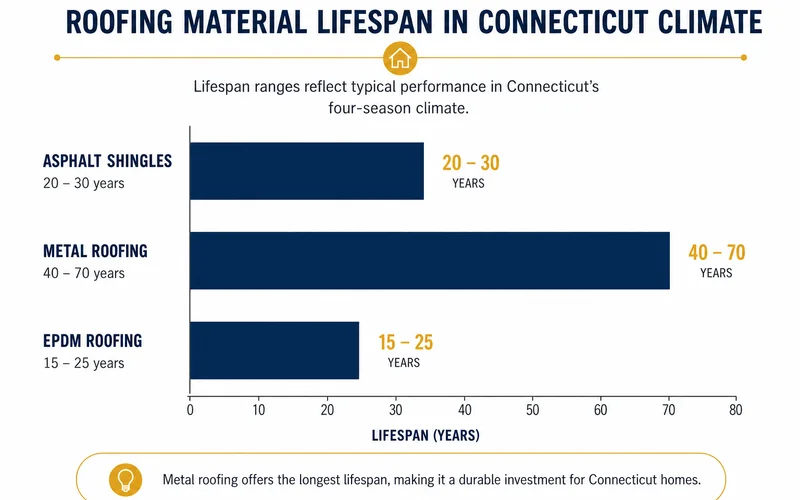
The baseline roof lifespan ct homeowners should expect is 20 to 25 years for standard architectural asphalt shingles. We see metal and rubber materials lasting significantly longer, often pushing past the 40-year mark when installed correctly.
| Material | Typical CT Lifespan | Best Case |
|---|---|---|
| 3-tab asphalt shingles | 12-18 years | 20 |
| Architectural asphalt shingles | 20-25 years | 28-30 |
| Designer architectural shingles | 25-30 years | 35 |
| Standing seam metal (concealed fastener) | 40-50 years | 60+ |
| Exposed-fastener ribbed metal | 25-40 years | 45 |
| EPDM rubber (60 mil) | 20-25 years | 30 |
| EPDM rubber (90 mil) | 25-30 years | 35 |
| TPO membrane | 20-25 years | 30 |
Real-world Connecticut performance tends to the shorter end of each range. Brands like GAF Timberline HDZ or Owens Corning Duration dominate the local market, making up over 80% of residential replacements in 2026. These specific architectural shingles offer excellent wind resistance, but they still battle our regional climate factors every single day. The image below illustrates how these materials compare in our specific environment.
The Connecticut Climate Tax
Four severe weather factors push actual longevity below the manufacturer warranty specifications. Our crews replace hundreds of roofs each season, and the damage patterns are always tied to these local elements.
The Impact of Winter Weather
Connecticut experiences up to 100 freeze-thaw transitions in a single year, particularly during late winter and early spring. Water seeps into tiny spaces, freezes, and then expands by about nine percent. This cumulative stress drives micro-cracking across the asphalt shingle lifespan.
Repeated ice dam cycles also severely damage the underlayment at the eaves. Homeowners might think their shingles look fine from the driveway, but water is secretly backing up under the surface. We highly recommend installing a premium barrier like Grace Ice & Water Shield to a height of 6 feet up the slope, rather than the building code standard of 3 feet. This extra row provides a critical defense against winter leaks.
Severe Storms and Summer Heat
Sustained wind gusts over 50 mph during events like the February 2026 Nor’easter place immense strain on the shingle sealant strip. The adhesive strip weakens after several major wind events. Shingles will then start lifting and blowing off during the next minor storm.
Summer humidity also takes a heavy toll on your home. High humidity drives the growth of Gloeocapsa magma, which creates those ugly dark streaks on north-facing slopes. This organism actually eats the limestone filler in asphalt shingles, accelerating UV-related granule loss and premature aging.
The Ventilation Factor
The single biggest variable determining ct roof age is not the brand of shingle you buy. The true deciding factor is the quality of your attic ventilation. A properly ventilated space allows a 25-year product to survive close to 25 years. A poorly ventilated system bakes that exact same material from the inside out, reducing its effective life to just 17 years.
Understanding Building Code Rules
Most property owners do not realize that airflow is strictly regulated by building codes. The International Building Code (IBC) standard uses a 1/300 rule for enclosed attic spaces. This means you need one square foot of Net Free Venting Area (NFVA) for every 300 square feet of attic floor space. If your attic is 1,200 square feet, your house requires 4 square feet of dedicated ventilation space.
We check these calculations during every single replacement estimate. A very common and destructive mistake is mixing different exhaust types on the same property. Combining gable vents with a ridge vent short-circuits the air flow, pulling rain or snow straight into your rafters instead of exhausting hot air.
The Cost of Upgrading
Bringing airflow up to current standards during a tear-off project is a relatively modest investment. Typical upgrades cost between $400 and $1,200. The return on that investment is massive because it protects the warranty and prevents premature shingle blistering.
When to Start Expecting End-of-Life Signs
Property owners should start monitoring their exterior closely before the warranty expires. These are not exact expiration dates, but rather the recommended start-watching milestones for proactive maintenance.
- Year 12 on basic 3-tab asphalt
- Year 15 on architectural asphalt
- Year 18 on commercial EPDM rubber
- Year 25-30 on standing seam metal
How to Safely Inspect Your Property
You do not need to climb a ladder to perform a basic health check. We advise grabbing a pair of 10x magnification binoculars and standing in your yard or across the street. Look closely for missing granules, curled edges, or shiny spots. A shiny reflection means the fiberglass mat is exposed, which is a confirmed sign that the material has reached the end of its functional life.
The specific red flags detailed in our signs your roof needs replacement guide usually show up 1 to 3 years before water breaches the interior. Spotting these early warnings saves you from dealing with emergency interior drywall repairs.
What Determines Whether Yours Is at the Short or Long End
Two houses in the same Hartford County neighborhood with identical materials can have completely different remaining lifespans. Several site-specific elements influence how quickly the materials degrade over a decade.
Environmental Stressors
The orientation of your house plays a massive role in weathering. South-facing slopes absorb intense daily UV radiation and often fail two to three years faster than the shaded north-facing sides. Heavy tree cover presents a completely different threat. Mature White Oaks or Sugar Maples common in our area drop heavy branches and trap thick layers of acidic leaves in the valleys. This trapped debris holds moisture directly against the shingles and accelerates rot.
Installation and History
Original installation quality dictates long-term performance. A contractor using a six-nail pattern rather than the standard four-nail pattern significantly improves wind uplift resistance. The storm event history at your specific address also matters, as repeated hail or wind events slowly degrade the system over time.
A professional evaluation gives you a calibrated, honest answer about your remaining timeline. We write detailed estimates that include a remaining-life projection, not just a blind replacement quote. Sometimes the professional answer is simply that you have five good years left, and you should call back in 2031.
Taking Action on Your Investment
A roof replacement is a major capital expense, and understanding your local risks is the best way to protect your budget. You can significantly extend the life of your current system by managing nearby trees, checking your attic airflow, and monitoring for early wear.
We strongly encourage scheduling a professional evaluation if your asphalt shingles are approaching that 15-year mark. Contact our office today to book a comprehensive inspection, and gain clear visibility into the true health of your property.