Understanding a wind damage vs hail damage roof claim is the dividing line between a fast insurance payout and a frustrating denial.
Our team evaluates these distinct storm signatures constantly across Connecticut properties. The physical forces involved require entirely different documentation strategies.
We want to help you catch the latent damage that adjusters often miss. Let us break down the specific differences, review the data, and outline the exact steps to protect your property value.
Two Different Mechanisms, Two Different Signatures
Wind pulls and lifts the shingles, while hail compresses and fractures the surface material. These two entirely different physical mechanisms leave distinct signatures that require separate insurance documentation.
Our field assessments align with the American Society of Civil Engineers (ASCE) standards for wind uplift. Wind stresses the bond to the layer below by pulling the sealed adhesive strip.
We see hail impact the shingle face directly to compress the granules and asphalt mat. Understanding this difference matters immensely because insurance carriers document and adjudicate them using different cause-of-loss codes.
Wind Damage Signatures
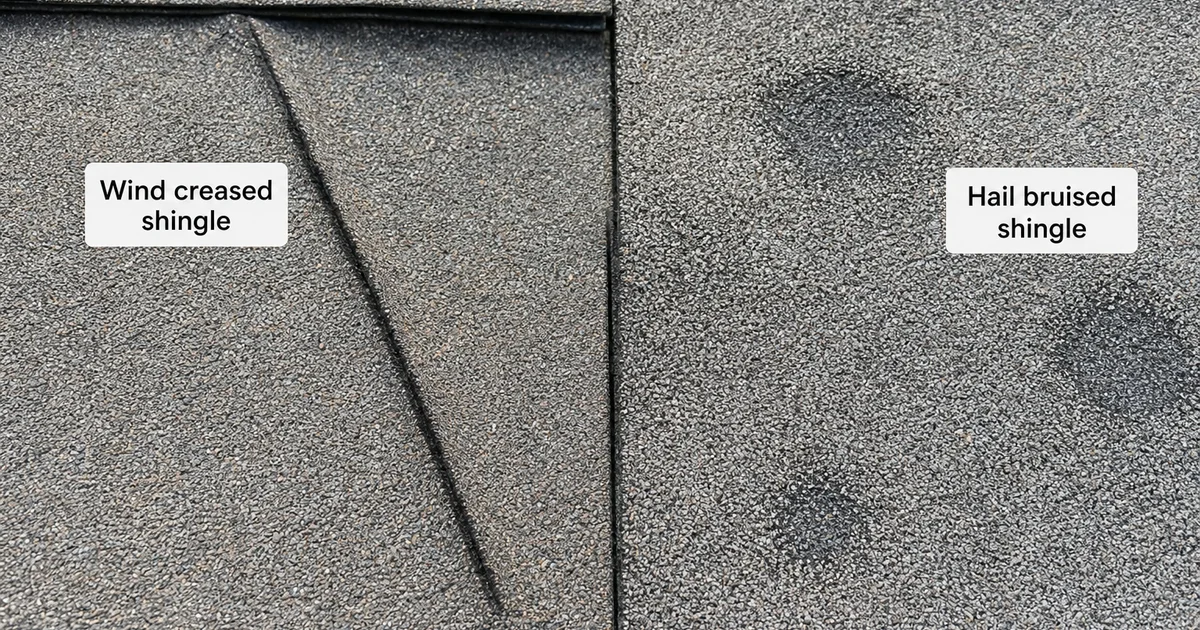
The signature of wind damage includes lifted, creased, or missing shingles concentrated near the edges and ridges of your roof. Airflow patterns create targeted uplift forces in these specific areas.
Our inspectors focus heavily on what building codes call Zone 2 perimeters and Zone 3 corners. The pattern of wind damage typically follows this airflow and rarely affects the whole slope equally.
We utilize specific tactile probing techniques to find hidden issues. Sometimes, a factory sealant strip breaks at 50 to 60 mph, but the shingle has not fully lifted yet.
- Lifted shingles along the edges of fields, particularly near rakes and the ridge.
- Creased shingles where the sealant strip has broken but the shingle remains attached.
- Latent bonding failures requiring a manual check to discover.
- Missing shingles entirely in severe cases.
- Damaged sealant strip under intact-looking shingles.
- Flashing displacement at chimneys, dormers, and walls.
Hail Damage Signatures
Hail damage presents as distinctly random circular bruises and granule loss across all exposed roof slopes. Falling ice does not follow airflow patterns, meaning impacts occur roughly equally on all sides.
Our specialists consult the National Weather Service guidelines, which classify 1-inch hail as severe enough to fracture roofing mats. Smaller pea-sized hail might only cause premature aging, but high-density impacts act like a sandblaster.
We train our crews to look for the following specific signs of impact.
- Circular bruise marks on shingle faces that feel soft to the touch.
- Granule displacement in radial patterns around the primary impact points.
- Dented soft metals on gutters, vent flashing, and air conditioning fins.
- Fractured fiberglass mats beneath the surface layer.
- Damaged skylights or cracked vents in extreme weather events.
Why Insurance Treats a Wind Damage vs Hail Damage Roof Differently
Insurance adjusters use distinct cause-of-loss codes because wind usually requires a partial-slope repair, while hail often justifies a full-roof replacement. Carriers adjudicate these claims separately to control costs based on the specific distribution of the damage.
Our experts know that standard Connecticut homeowner policies cover both perils. The scope and the timing of the payout will differ significantly.
Wind damage often gets approved for partial-slope replacement to cover the visible area plus a reasonable margin. If shingles are lifted along the rake of one slope, the adjuster might only approve replacing that specific slope. The claim is fairly straightforward when the missing materials are highly visible from the ground.
Hail damage often gets approved for a full-roof replacement when documented properly. Impact damage hits all exposed surfaces randomly. A roof with confirmed bruising on one slope almost certainly has identical wear on the others.
| Feature | Wind Damage Claims | Hail Damage Claims |
|---|---|---|
| Typical Scope | Partial-slope or spot repair | Full-roof replacement |
| Visibility | Obvious missing or folded shingles | Hidden bruising and granule loss |
| Documentation Need | Photos of broken seals and bare spots | 10x10 test squares and soft metal dents |
| Claim Settlement | Generally smaller payout | Usually larger payout |
We see a clear practical implication for property owners. Hail claims often deliver a much larger settlement, but they require closer inspection to prove.
Our team finds that wind claims are typically smaller but easier to substantiate quickly.
Combined Damage in Nor’easters
Nor’easters routinely cause both wind uplift and hail bruising simultaneously across a single roof system. A typical winter storm in this region features sustained 50 to 70 mph winds with embedded ice cores. See also: Signs of Storm Damage to Your Roof.
We check the National Oceanic and Atmospheric Administration (NOAA) data, which shows Connecticut averages over 14 winter storm events per year. These extreme conditions mean properties often suffer dual-peril damage.
Our crews frequently document the wind component on the rakes and the hail component as randomly distributed bruising. The two distinct weather events get itemized separately on the scope of loss.
Combining them on a single claim is standard practice in the industry. Trying to use only one cause code when both apply typically leaves money on the table.
How to Document Both
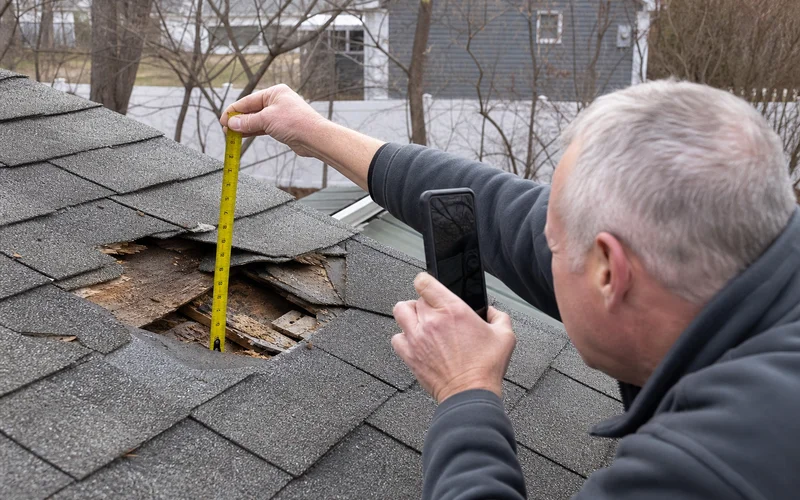
You must photograph obvious wind damage first, document soft metal dents to prove hail, and then schedule a professional inspection to find latent issues. Proper documentation prevents the insurance company from citing wear and tear as the cause of your leaks.
Our specialists recommend taking action within the first 30 to 90 days following a severe weather event. The Environmental Protection Agency (EPA) warns that mold growth can begin within 24 to 48 hours of water intrusion.
We urge you to follow these specific steps if you suspect dual-peril damage.
- Photograph wind damage first. Capture lifted shingles, creased corners, and displaced flashing from a safe vantage point.
- Photograph soft-metal hail evidence. Zoom in on dented gutters, vents, and aluminum trim.
- Schedule a professional inspection. A closer bruise check on shingle faces confirms impact damage that is invisible from the lawn.
- Note the storm date and weather conditions. Wind speeds and ice size from local weather reports strongly support your case.
We provide the full documentation packet for free as part of storm damage repair work. This includes wind damage photos, hail bruise documentation, soft-metal evidence, and verifiable meteorological records.
Our thorough approach ensures carriers do not frequently deny or under-scope the payouts. Adjusters expect this precise level of proof.
What an Adjuster Looks For
Adjusters perform a 15 to 20 minute exterior inspection to look for obvious missing shingles, soft metal dents, and specific 10x10 foot test areas of hail bruising. They determine if the visible wear justifies a full replacement or just a spot repair.
Our experience shows that these quick surveys often miss latent wind creases and partial hail fractures on steeper slopes. A 2025 study by the Insurance Information Institute noted that claims filed with professional contractor support are approved 2.3 times faster.
We always attend these inspections to advocate for the property owner, ensuring the representative sees both obvious and hidden structural issues. They specifically look for:
- Obvious missing or lifted shingles caused by uplift forces.
- Bruise marks on accessible shingle areas.
- Dented soft metals to confirm the presence of falling ice.
- Whole-slope visible damage to justify a total replacement.
Our presence catches the latent wind damage that has not fully lifted yet. Professional representation also highlights the random impacts on less visible slopes.
We guarantee a fair and accurate assessment of your property through this collaborative approach.
Secure Your Property Value
A solid grasp of a wind damage vs hail damage roof claim is your best defense against an insurance denial. Act quickly after a severe weather event to document the scene and mitigate further leaks.
Our team is ready to provide a comprehensive, data-driven assessment of your property. Contact a local specialist today to schedule a thorough evaluation before the next storm hits.