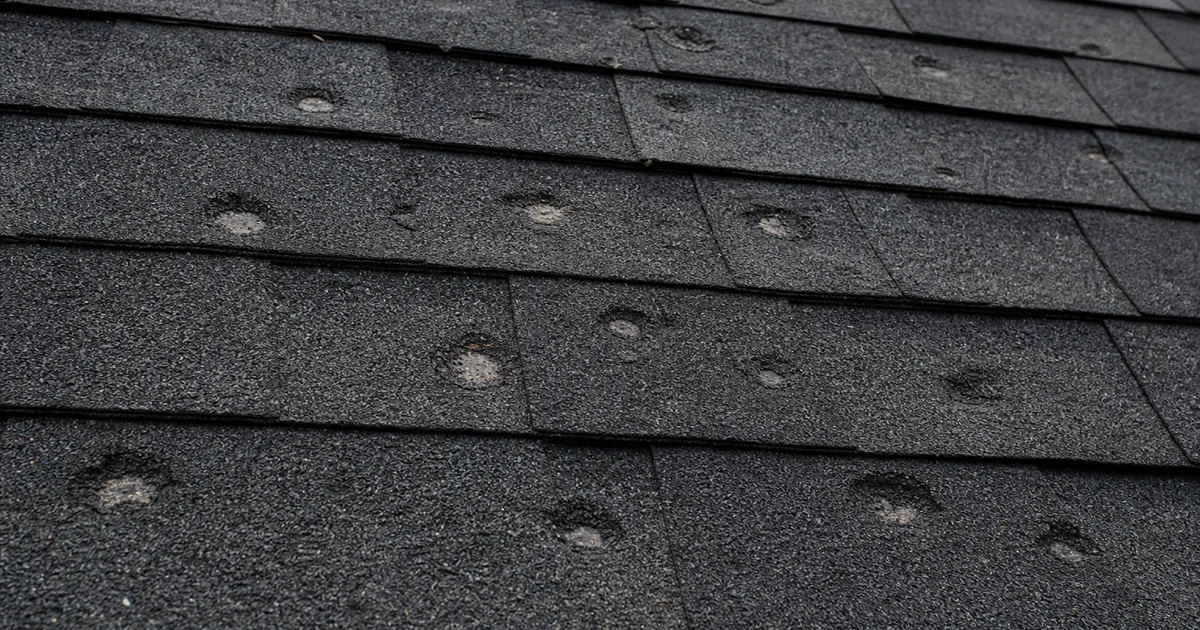
We notice that many property owners only ask, “what does hail damage on a roof look like?” when a visible leak appears on their ceiling. The reality is that hailstorms compromise the long-term integrity of your shingles long before water ever breaches your living room. A 2026 review of standard Connecticut homeowner policies shows that missing these early warning signs often leads to denied claims later. For the full scope of work behind this guide, see our storm damage service.
Our team always recommends catching these issues early to secure a favorable insurance settlement. Let’s look at the data, what it actually tells us about impact damage, and then explore practical ways to respond. These facts will give you the confidence to handle any adjuster.
What Does Hail Damage on a Roof Look Like?
We see a lot of confusion regarding the actual appearance of storm impacts on standard asphalt roofing. Hail damage on asphalt shingles has a distinctive signature that looks entirely different from age-related wear, foot-traffic scuffing, or installation marks. Once you know exactly what to look for, you can spot these indicators during a close-up inspection.
Our trained crews look for specific indicators of functional damage that compromise the water-shedding ability of the material. Identifying these marks correctly is the key to proving a loss to an adjuster. This visual evidence separates a valid insurance claim from a standard maintenance issue.
The Three Tell-Tale Signs
We evaluate storm damage using the strict guidelines established by HAAG Engineering, the industry standard for roofing inspections. Adjusters rely on the “test square” method, measuring a 10-foot by 10-foot area to count verifiable impact marks. Most major carriers like Travelers and State Farm require finding 8 to 10 distinct hits within this 100-square-foot zone to approve a full replacement.
Our inspectors document three primary indicators to meet this strict threshold.
- Circular bruise marks. Hail impacts produce small, roughly circular spots where granules are knocked off and the underlying asphalt mat is bruised. These look slightly darker than the surrounding shingle and feel softer to the touch. Our technicians can feel a bruise the way you would feel a small dent in a peach.
- Granule displacement patterns. Around each impact, granules are pushed outward in a small radius. You will see slight color rings where the granule density has changed, exposing the fiberglass mat underneath. Our local clients frequently find heavy granule accumulation washing out through their downspouts post-storm.
- Dented soft metals. Hail dents gutters, downspouts, vent flashing, aluminum AC condenser fins, and metal trim. These dents provide a highly visible confirming indicator that hail of sufficient size hit the property. Our photo reports always highlight these metal dents because they are undeniable proof of a severe storm. These facts provide the exact evidence needed. Nothing is left to interpretation.
Hail Size and Damage Threshold
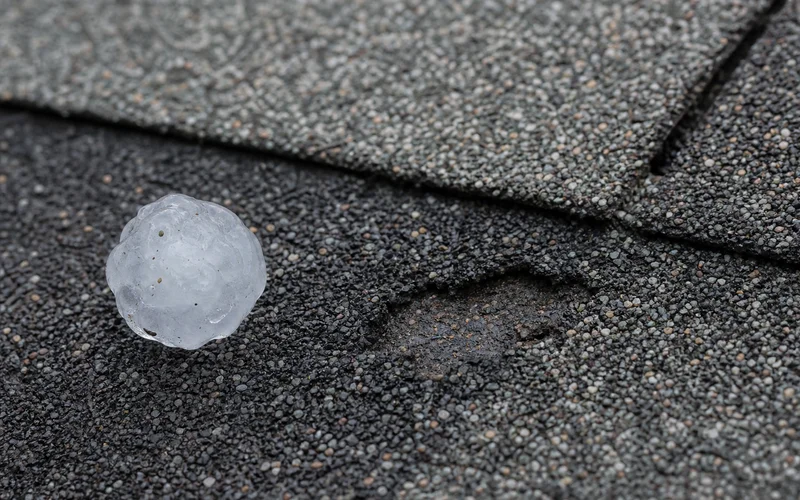
We use local meteorological data to understand the exact size of hailstones that fell on your neighborhood. The National Weather Service and the NOAA Storm Prediction Center classify severe hail as anything reaching 1 inch in diameter or larger. Connecticut homeowner policies generally use this 1-inch mark as the baseline for validating shingle damage claims.
Our roofing specialists know that anything smaller rarely causes enough structural harm to warrant a full roof replacement. The relationship between hail size and shingle damage is clearly defined across the industry. This threshold table shows exactly what to expect based on the weather reports.
| Hail Size | Damage Likelihood | Shingle Material Impact |
|---|---|---|
| Under 0.5” | Negligible on shingles; light dents on soft metal only | Standard 3-tab shingles survive easily |
| 0.5” - 0.75” | Possible on aged shingles; visible dents on most soft metal | Architectural shingles show no functional loss |
| 0.75” - 1” | Damage on aged shingles; cosmetic-to-structural on newer roofs | Class 4 impact shingles resist bruising |
| 1” - 1.5” | Insurance-claim-relevant damage on most asphalt shingle roofs | Standard shingles suffer granule displacement |
| Over 1.5” | Significant damage; often requires full replacement | Even premium materials sustain heavy damage |
We highly recommend upgrading to Class 4 impact-resistant products, like Owens Corning Duration FLEX or GAF Timberline HDZ, if you live in a storm-prone area. These premium shingles feature modified asphalt that dramatically increases resistance against 2-inch hailstones. Many Connecticut insurance carriers offer substantial premium discounts for installing these reinforced systems.
Our clients frequently save up to 10% on their annual homeowner premiums after completing this upgrade. The initial material investment pays for itself through these long-term insurance savings. This durability also provides massive peace of mind during the spring storm season.
What Hail Damage Is NOT
We frequently encounter property owners who mistake normal material aging for sudden storm devastation. An honest inspection differentiates true impact damage from unrelated cosmetic issues. Blistering is a perfect example, as it is a manufacturing defect caused by trapped moisture expanding in the sun, creating raised bumps that pop. See also: Signs of Storm Damage to Your Roof.
Our experts will quickly point out that hail leaves a depressed bruise, while blisters pop outward. Several things look like hail damage but require a different approach. Discriminating between these marks is vital before contacting an agent.
- Granule loss at the dripline: Our initial sweeps often reveal this issue, which results from heavy rain over time rather than a sudden impact.
- Algae streaks: These black stains are actually Gloeocapsa magma algae, making them another false alarm. This organic growth is entirely cosmetic and non-structural.
- Old foot-traffic scuffs: We also check for these scuffs, which are linear and localized to areas where workers walked.
- Manufacturing marks: These factory defects create uniform patterns that are present immediately on brand-new shingles.
- Aged shingle wear: This natural deterioration appears uniformly across the entire roof field, lacking isolated impact craters.
We suggest scheduling a professional evaluation specifically because discriminating real hail damage from these look-alikes dictates whether you should file a claim. Filing a claim for normal wear and tear will result in a swift denial. This puts an unnecessary mark on your insurance record.
The Touch Test (For Inspectors, Not Homeowners)
We physically touch the shingles during an assessment to confirm what the eyes see from a distance. A real hail bruise feels slightly soft when you press a fingertip on it, indicating the asphalt mat under the granules has been compressed. A cosmetic-only impact does not feel different and will not qualify for an insurance payout.
Our primary goal is documenting functional damage that actually threatens the waterproofing of your property. This physical test is not something a homeowner should attempt while balancing on a pitched roof. The ground walk-around and the gutter check tell you whether you have enough evidence to call a professional.
Our local crews are ready to step in when you decide to schedule a free post-storm inspection. The closer-look bruise discrimination is exactly what happens during that specialized evaluation. Safety should always remain the top priority during any exterior home assessment.
Documenting Hail Damage for Insurance
We approach the documentation phase knowing that adjusters require overwhelming proof to authorize a payout. In 2026, the average roof replacement in Connecticut costs between $11,200 and $20,700, meaning insurance companies scrutinize every detail. Modern claims adjusters use sophisticated tools like CoreLogic Hail Verification Reports to cross-reference your reported loss date with historical radar data.
Our documentation packet is engineered to meet and exceed these strict evidentiary standards. If hail damage is confirmed and you decide to file, the documentation needs three specific things. Each element plays a critical role in the approval process.
- Storm-event proof: We gather exact dates, locations, and hail size estimates from National Weather Service reports.
- Photo evidence of damage: This step requires high-resolution close-ups of the chalked test squares, granule patterns, and dented soft metals.
- Roof-condition baselines: You must establish the installation date and demonstrate a history of routine maintenance.
We provide this comprehensive packet at no cost as part of our storm-damage advocacy service. Adjusters expect this high level of detail to process the paperwork smoothly. Without professional evidence, claims routinely get denied or severely under-scoped.
Our team ensures your file is airtight before you ever dial your agent’s number. This proactive strategy removes the stress from the claims process. You gain complete clarity on the condition of your home.
When to Schedule the Inspection
We advise property owners to initiate the inspection process within 7 days of a severe weather event. While standard HO-3 policies in Connecticut technically allow up to 365 days to report a loss, waiting months is a massive mistake. Beyond 90 days, insurance carriers start questioning the storm-event causation, aggressively blaming subsequent rain or wind for the current issues.
Our experience shows that prompt reporting directly correlates with higher approval rates. The Connecticut Department of Insurance actively encourages homeowners to mitigate further interior damage by acting quickly. Leaks from undetected hail impacts will destroy attic insulation and drywall, drastically increasing your out-of-pocket expenses.
We offer an honest read on whether the situation is claim-worthy, complete with photo documentation. Call (203) 824-0275 today to schedule your assessment and protect your property. Knowing exactly what hail damage on a roof looks like gives you the power to make the right call.