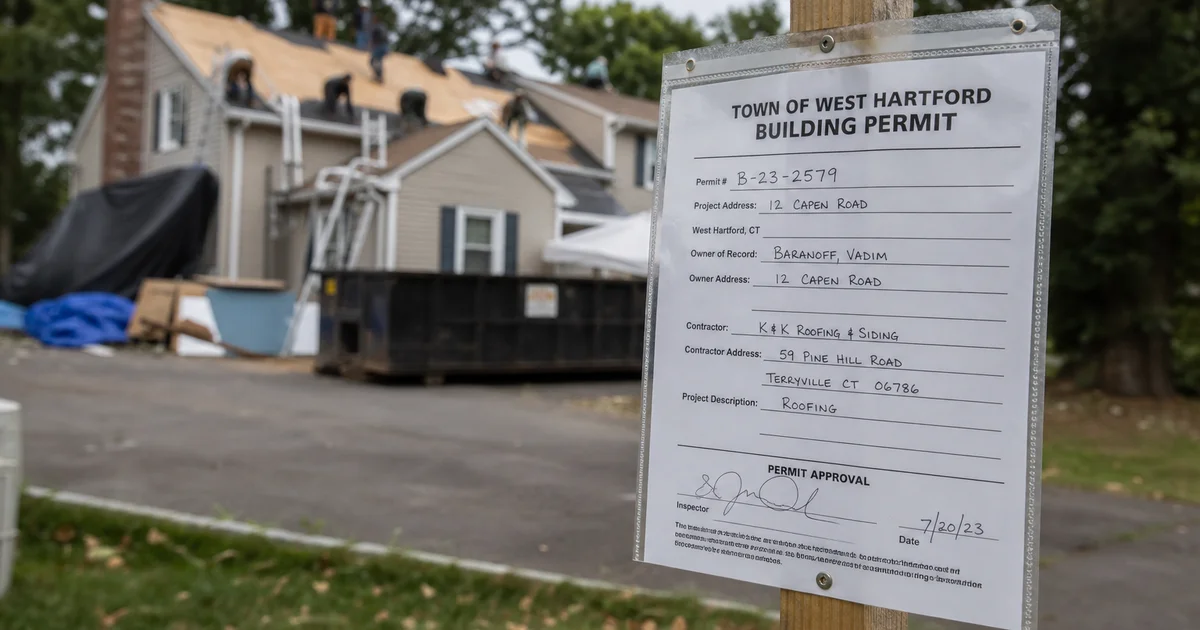
We know exactly how confusing the state building regulations can be for local property owners.
The transition to the 2026 Connecticut State Building Code adds another layer of difficulty to property repairs. Finding clear answers about local compliance often feels like a frustrating guessing game.
Our team has handled hundreds of these applications across Hartford County to ensure local homes stay completely compliant.
A properly documented roof replacement protects your property value and ensures insurance compliance.
Let’s review the current connecticut roofing permit requirements so you know what to expect. We will walk through the exact local thresholds so you can make informed decisions.
When a Permit Is Required in Connecticut
You must obtain a building permit for any full roof replacement in Connecticut. The state regulations establish strict connecticut roofing permit requirements for all complete structural teardowns.
We track these local mandates daily to ensure every job meets compliance. The incoming 2026 Connecticut State Building Code (based on the 2024 International Residential Code) sets the baseline for these rules.
Individual municipalities then apply their specific fee structures and minor local thresholds. Our permit coordinators handle this entire application process for you.
- Full tear-off and replacement: Always requires a building permit across all Hartford County municipalities.
- Partial replacement: Work covering one full slope or larger almost always triggers the permit requirement.
- Repairs under 100 square feet: These minor fixes typically skip the permit process, though Hartford has slightly different rules.
- Emergency tarping: This is a temporary stopgap measure and never requires documentation.
Who Pulls the Permit (And Why It Matters)
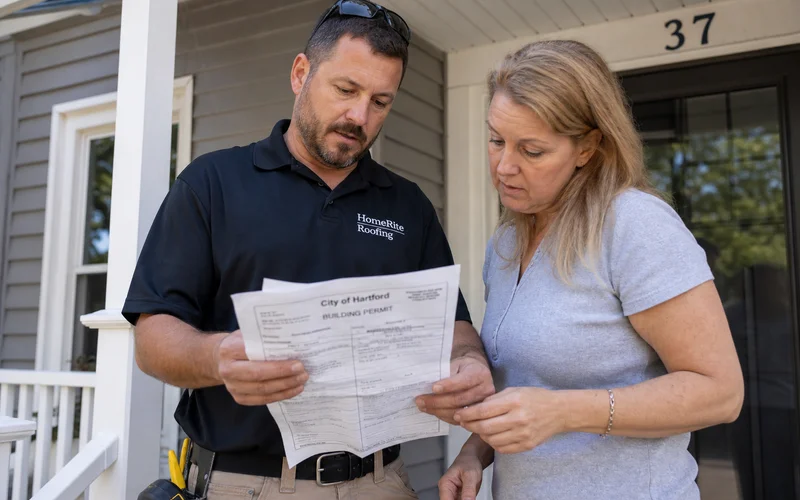
A licensed roofing contractor must pull the paperwork for your project. This is never a task you should handle yourself.
We submit an active Home Improvement Contractor registration directly to the Department of Consumer Protection to validate the application. The building department requires this proof of insurance and licensing right at the counter.
Homeowners who file the application themselves inadvertently signal that the job is a DIY project. Our process prevents unlicensed workers from bypassing the state accountability checks.
| Application Filer | Legal Liability | Inspection Standard | Red Flag Warning |
|---|---|---|---|
| Licensed Contractor | Assumed by the business | Professional grade | None |
| Homeowner | Assumed by the property owner | DIY residential standard | Contractor is avoiding checks |
An honest contractor will gladly present their credentials to the town clerk. Any request for you to handle the filing is a massive warning sign.
We strongly recommend finding a different professional if a company asks you to do this paperwork.
How Connecticut Roof Inspections Work
Your project will undergo at least one final review by a municipal building official. Most complete teardowns actually require two separate site visits. See also: How to Choose a Roofing Contractor in Connecticut.
Our field supervisors schedule these mandatory checks directly with the town.
Standard Residential Inspection Phases
The exact number of visits depends on the complexity of your property. A standard structural overhaul usually follows a two-step verification process.
We coordinate the timelines so you never have to wait around at home.
- Mid-project inspection: The official checks the decking condition and ice-and-water shield placement before shingles go down.
- Final inspection: A conclusive review confirms the finished installation matches the original approved scope.
Simpler scopes might be consolidated into a single final check. A successful roofing inspection connecticut property owners pass will officially close out the municipal file.
Our team tracks this final approval to ensure your records are pristine.
What Happens If a Previous Roof Wasn’t Permitted
The current property owner inherits the legal and financial burden of unpermitted work. This issue frequently surfaces during a title search or a mortgage refinance.
We see this scenario constantly when helping buyers update an older house. The state notes that working without documentation can trigger severe penalties.
Municipalities like Newington actively assess a fee of 200 percent of the regular permit cost for unapproved construction. Our goal is to fix these historical errors during your next replacement.
- Insurance claims: Carriers frequently deny payout requests if the damaged structure was never legally approved.
- Resale disclosure: State law mandates that sellers disclose known unpermitted alterations, which often leads to closing credits.
- Code compliance: Major renovations can be halted entirely if the existing structure lacks municipal approval.
You do not have to retroactively permit the old, faulty installation. A fresh, fully documented replacement essentially resets the clock for your property.
We handle the new application to clear the slate with the local inspector.
Newington and Hartford County Specifics
Every municipality applies its own unique fee schedule and processing portal. Prices generally range between 150 and 500 dollars depending on your exact town and project size.
We process paperwork in these local offices every single week. The newly updated fee structure for a newington building permit reflects recent municipal changes.
Other neighboring towns like Hartford utilize the OpenGov digital portal for transparent scheduling. Our detailed estimates always separate these exact town charges from your labor costs.
| Municipality | Application Method | Estimated 2026 Fee Range | Local Nuance |
|---|---|---|---|
| Newington | In-person / Online | $200 to $450 | $50 base fee for first $3,000, plus $15 per additional $1,000 |
| Hartford | Accela / OpenGov Portal | $250 to $500+ | Historic-district overlays require extra aesthetic review |
| West Hartford | Digital Portal | $200 to $400 | HOA reviews are processed separately from town approvals |
Towns like Manchester, Bristol, and South Windsor follow standard state residential guidelines. The final costs in these suburbs consistently sit within that standard 150 to 500 dollar window.
We print the exact municipal receipt for your personal records.
Why This Matters for Buyer Protection
A documented ct roof permit proves the structural integrity of your home to future buyers. It serves as a tangible, verifiable asset during any real estate transaction.
Our clients appreciate this peace of mind when selling a house within ten years of the work. Long-term residents gain a powerful defense against strict insurance adjusters.
A formal municipal sign-off blocks carriers from disputing the quality of the installation after a storm.
- Resale Value: Provides documented proof of structural standards.
- Insurance Defense: Prevents adjusters from denying claims based on workmanship.
- Liability Protection: Transfers all compliance risk away from the property owner.
We build this security right into the roof replacement process. You never have to chase the local clerks or worry about missing signatures.
Following these connecticut roofing permit requirements is simply how a professional job gets done. Our office is ready to schedule a thorough, compliant evaluation of your property today.